
What should you check before hanging a heavy mirror?
Start with the mirror's weight, its intended hanging method and the wall behind it. Find the product instructions and confirm that the mirror is designed for wall mounting in your chosen orientation. A decorative frame, floor-standing support or carrying handle is not automatically a suitable hanging point.
Use the manufacturer's unpacked weight for the complete mirror, including its frame. If the weight or hanging method is missing, ask the supplier before buying fixings. Check the glass, frame and rear fittings for damage or looseness.
Scroll across to see all columns.
| Rear fitting | Information to obtain |
|---|---|
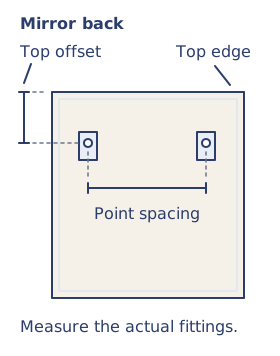
| Separate keyholes or D-rings | The intended wall attachments, mounting-point spacing and offset below the top edge. Do not join them with wire unless the maker permits it. |
| A rail or cleat | The matching wall part, its orientation, specified fixing positions and clearance needed to engage the mirror. |
| A locking clip or retainer | Its model-specific fitting sequence and how to confirm it is engaged after hanging. |
Photograph the fittings while the mirror is safely supported in the position allowed by its instructions. Do not dismantle its back or lean unstable glass just to identify the hardware.
The fixings supplied in the box may suit only particular walls. B&Q's mirror installation guide makes this distinction explicitly. The screw head must also fit the mirror's bracket or keyhole correctly. A fixing that suits the wall still needs to work with the mirror's hardware.
Which wall fixings do you need?
Choose fixings for the actual wall construction, mirror weight and mounting arrangement. Plaster is a surface finish, so finding plaster alone does not identify the supporting material. A hollow sound also cannot tell you whether you have a stud partition or plasterboard with masonry behind it.
Scroll across to see all columns.
| Wall construction | Check first | Fixing route to assess |
|---|---|---|
| Brick, block or concrete | Exact material and condition beneath the finish | Fixings specified for that masonry and the mounting load |
| Timber stud behind plasterboard | Stud position and compatibility with the mirror's mounting points | Suitable fixings into sound timber, following the mounting instructions |
| Plasterboard with a cavity | Board thickness, condition and space behind it | A rated cavity fixing suited to those conditions |
| Plasterboard over masonry | Board thickness, gap and masonry behind it | A compatible system that bridges the gap and anchors into the masonry |
These differences matter: fischer's DuoTec data specifies board and cavity dimensions, while its DDF system bridges plasterboard to masonry. Neither is a universal mirror fixing. Check the complete assembly, including screw compatibility, rather than adding together headline load ratings. Seek advice for metal studs, old lath and plaster or uncertain construction.
How do you prepare and mark the position?
Confirm that the proposed fixing positions can be used safely before drilling, then transfer the mirror's actual hanging measurements to the wall. Choose the height for the people using the mirror and the furniture around it. Use a paper outline to check the position without repeatedly lifting heavy glass.
Measure the spacing between mounting points and their distance below the mirror's top edge. Transfer those measurements with a tape measure and spirit level. Dunelm's hanging guide also suggests a masking-tape template for the spacing.
Check for concealed pipes and cables with an appropriate detector, following its instructions. A clear reading is not a guarantee: Bosch documents detection limits caused by depth and wall materials. Stop if services cannot be assessed confidently. Clear the lifting route and prepare a protected resting place for the mirror.
How do you fit the fixings and hang the mirror?
Install the selected fixing system exactly as its manufacturer specifies, then engage the mirror's hanging fittings fully before releasing its weight. The required hole size, depth, installation tool and screw position depend on the system. There is no single drilling setting or anchor count that suits every heavy mirror.
- Move the mirror out of the work area. Protect nearby surfaces and use the protective equipment specified for the tools and materials, including eye protection.
- Follow the fixing instructions. Check the required bit, drill mode, hole preparation, embedment and tightening method. Stop if the hole enlarges, the fixing spins or the wall crumbles.
- Prepare the hanging hardware. Fit the brackets, retainers or mirror washers required by the mirror's instructions. Do not overtighten fixings against glass; B&Q warns that this can crack it.
- Lift with sufficient help. Keep the mirror supported while checking that every intended attachment is seated. Fit any specified locking parts, check the level and release the weight carefully. If anything moves or feels uncertain, support and remove the mirror for reassessment.
When should you ask for help hanging a mirror?
Ask for help when the wall construction or fixing suitability is uncertain, the mirror is difficult to handle, or the location makes lifting awkward. Damaged plasterboard, crumbling masonry, missing hanging instructions and fittings that do not line up with suitable support need assessment before the mirror goes on the wall.
Colin Home Service offers mirror hanging and mounting help. Check the areas covered, then include these details in your mirror hanging enquiry:
- Your postcode and a wall photo.
- The mirror's dimensions, weight and instructions or product link.
- Photos of rear brackets and supplied fixings.
- Known wall construction and any damage or old holes.
- Proposed position and access restrictions, such as stairs or furniture.
This helps establish the materials and checks needed before work is agreed.
Sources used in this guide
Need help hanging your mirror?
Send Colin the mirror and wall details listed above, with your postcode, to discuss the mounting work.
Shelf and mirror fitting enquiries are welcome from Kingston, Richmond and Merton.
Message me on WhatsApp