
Where should the curtain pole go?
Choose the pole position from the curtain heading, finished drop and space around the window. A suggested distance above the frame is a starting point, not a rule that overrides curtains you already own. This guide covers a standard straight pole on mechanically fixed wall brackets; bay poles, ceiling tracks and blind cord systems need their own instructions. A tension rod held between two surfaces uses a different support method, so advice about its grip does not repair a bracket pulling out of a wall.
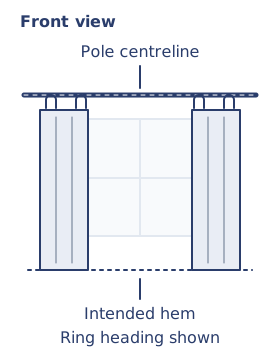
Check where the fabric hangs from. Pencil-pleat curtains on rings hang from hooks below the pole, while eyelet curtains have fabric extending above it. Use the curtain maker's measuring method to work backwards from the intended hem position. Dunelm's measuring guide distinguishes these heading measurements. If buying new curtains, establish the pole position before taking the final drop measurement.
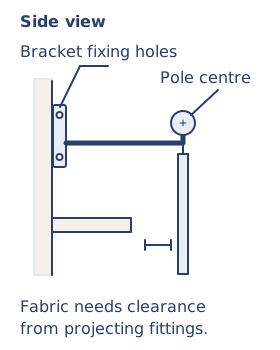
Record three separate positions: the intended hem, the pole centreline and the bracket's actual fixing holes. They are not the same measurement. Hold the bracket in its intended orientation to transfer its hole positions after the curtain height is settled. Check that the proposed position still leaves room for the heading, finials and a suitable fixing location.
Allow space beside the window for the curtains to gather when open, known as stack-back. Include the finials in the overall width and check for adjacent walls or cupboards. Check the bracket projection too: fabric should clear projecting handles and the sill. A radiator beneath the window affects both the drop and projection; avoid trapping its heat behind the curtains and follow its clearance instructions. Jim Lawrence explains extended brackets for projecting frames or radiators. Do not stretch an adjustable bracket beyond its approved range.
How many brackets does a curtain pole need?
The pole's instructions determine its bracket count and positions. Check the pole length, curtain weight, joints and bracket type together. A centre support may be required because of the span or curtain load, and a joint may need support even when the pole does not visibly bend.
There is no reliable rule that every pole uses two brackets or needs a third at the same length. For example, Jim Lawrence's product guidance gives different unsupported spans for different diameters. Treat those figures as guidance for those products, not another brand's pole.
Check that the pole, brackets, rings and finials fit each other. An ordinary centre bracket can prevent standard rings crossing the middle, so confirm how the curtains are intended to open before marking. Read the assembly order: some sleeve brackets must go onto the pole before its sections are joined. Missing instructions are a reason to ask the supplier, rather than guess.
Which curtain pole fixings suit the wall?
Select fixings for the material supporting each bracket, not simply the painted surface. Plasterboard over a cavity differs from plasterboard over masonry. Supplied plugs may not suit your wall, and an old hole does not prove that the previous fixing was suitable. Include the pole and curtains when assessing the load.
Scroll across to see all columns.
| Wall or symptom | Check | Next decision |
|---|---|---|
| Brick, block or concrete | Material and condition beneath the finish | Choose fixings approved for that masonry and bracket arrangement |
| Timber stud partition | Stud location and bracket hole positions | Assess suitable fixings into sound timber; do not assume the stud lines up |
| Plasterboard with a cavity | Board thickness, condition and cavity depth | Assess a compatible cavity fixing, including its screw requirements |
| Plasterboard over masonry | Board, gap and supporting masonry | Assess a system suited to bridging that construction |
| Loose bracket or enlarged holes | Failed fixing and surrounding damage | Unload the pole and assess the support before choosing a repair |
fischer's DuoTec data specifies cavity and board requirements; its DDF system addresses plasterboard over masonry. These are examples of construction-specific systems, not universal recommendations. Old lath and plaster, metal studs or uncertain support need assessment. The heavy mirror guide explains the same wall-identification problem.
How do you mark and fit the curtain pole?
Transfer the chosen pole position to the actual bracket holes, check the marks with a spirit level and fit the selected system to its instructions. Prepare a tape measure, pencil, level, appropriate detector, stable access equipment and the tools specified for the wall fixings. Have help available to support a long pole.
- Check the drilling positions. Assess concealed pipes and cables before making holes. Use a suitable detector as instructed, but do not treat a clear result as proof of safety. Bosch documents detection limits involving depth, moisture and wall materials. Stop if the positions cannot be assessed confidently.
- Mark from the brackets. Check the pole's centreline, hold each bracket in its intended orientation and mark through its fixing holes. Recheck the level across all supports; the window frame may not itself be level.
- Fit the fixings and brackets. Use the specified hole diameter, depth, drill mode and installation method. Wear the protection required for the tools and material. Stop if a hole crumbles or a fixing spins. Check bracket position before final tightening.
- Assemble and secure the pole. Follow the pole's sequence for joints, rings, curtains and finials. Only shorten a pole when its maker permits it. Seat it in every support and tighten the specified retaining screws.
- Check normal operation. Hang the curtains and open and close them gently. Check hem clearance, snagging, pole movement and each bracket. If a bracket moves or the wall cracks, stop using the pole and support it while arranging reassessment.
Jim Lawrence's fitting guide illustrates why bracket orientation, assembly order and pole retainers matter. Your own product instructions control the final installation.
What if the curtain pole is coming out of the wall?
Take the curtain load off a loose pole safely and assess the bracket, fixing and supporting wall before refitting. A spinning plug, enlarged hole, damaged board and loose bracket screw are different faults. Tightening harder can damage the surface further, and adding a stronger-looking screw does not repair failed support.
Scroll across to see all columns.
| What happens? | What to assess |
|---|---|
| Pole is level and secure, but curtains will not open fully | Stack-back space, rings, joints and whether the centre bracket blocks the intended travel |
| Pole bows between secure supports | Pole specification, span, joints, curtain weight and the maker's support arrangement |
| Pole moves in an otherwise firm bracket | Whether it is seated correctly and its specified retainer is present and secure |
| Bracket moves at the wall or cracks appear around it | The wall, fixing and surrounding damage; stop using and unload the pole safely before repair |
Adding a centre bracket addresses neither every movement fault nor every opening problem. It must suit the pole and curtain travel, and its own wall attachment must be sound. Similar distinctions between a bending component and a moving attachment are explained in the shelf support checks.
Do not fill a failed fixing hole with ordinary decorating filler and assume it can take the curtain load when redrilled. The next fixing needs suitable support and an appropriate installation method. Any replacement position still needs checks for hidden services. B&Q's curtain guide identifies unsuitable wall fixings and curtain weight as causes to check when brackets loosen.
For curtain pole fitting help, send the pole's product link, curtain details, a full window photo and close-ups of any damage with your enquiry. If you are in Richmond upon Thames, include your postcode to check coverage. You can also browse the other practical home guides.
Sources used in this guide
Need help fitting a curtain pole?
Send me your postcode, the pole's product link, curtain details and window photos. Include any old fixing damage so we can discuss the work before booking.
Curtain pole fitting enquiries are welcome from Kingston, Richmond and Merton.
Message me on WhatsApp