
What will the shelf hold?
Start with the shelf model, dimensions and intended contents. Books, plants and small ornaments place different demands on a shelf. Record the product's load limit and installation conditions before deciding where it goes.
The limit belongs to the complete installation. For example, IKEA's 30 x 26cm LACK shelf lists a maximum load of 3kg dependent on wall and fastening, with wall screws supplied separately. That figure does not apply to every LACK size or another manufacturer's shelf. Use the instructions for your exact article number.
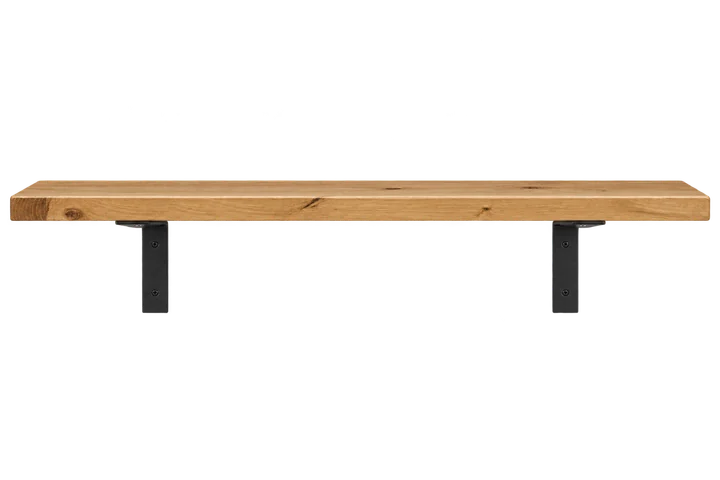
Check whether the shelf uses separate brackets, a wall rail or concealed supports. Make sure all retaining parts are present. A shelf that slides onto rods can still require a locking screw; appearance alone does not tell you when assembly is complete.
Which wall and fixings are you working with?
The wall's surface finish is not its supporting construction. Establish whether the proposed points meet masonry, timber studs, cavity plasterboard or plasterboard over masonry. Check the condition around each fixing, including earlier repairs.
fischer's DDF system illustrates a fixing designed to bridge plasterboard and the gap to masonry. It is not interchangeable with a fixing intended only for a board cavity. The selected system must suit the wall, bracket holes, screw requirements and mounting load.
If you cannot establish the construction or assess the fixings, stop before drilling. Do not infer capacity by adding together figures printed on a packet of anchors. Shelf depth, support geometry and the manufacturer's installation conditions matter too.
Plan the height and bracket positions.
Check usable space above the shelf and access below it. Mark the intended top surface, then use the actual bracket or mounting rail to locate its holes. Allow for the shelf thickness and how it sits on its supports.
Wickes' shelf guide explains marking from a centre point and checking the supports with a spirit level. Bracket spacing depends on the shelf and contents, so use your product's instructions rather than a universal spacing rule.
Assess concealed pipes and cables before making holes. Use an appropriate detector as instructed, but do not treat silence as proof of a clear wall. Bosch's UniversalDetect manual describes limitations involving depth, material and conditions. Uncertain results need further assessment, not exploratory drilling.
How do you fit the shelf?
Have the shelf instructions, selected fixing instructions, a level and measuring tools ready. Protect the area and use the protective equipment specified for the tools and materials. Arrange help if you cannot hold the components securely while positioning them.
- Recheck the marks. Confirm the approved fixing points, level and clearance using the actual supports.
- Install the wall fixings. Follow their specified hole diameter, depth, drill mode, hole preparation and tightening method. Stop if a hole crumbles or the fixing spins.
- Secure the supports. Check alignment before final tightening. Do not force a bent or misaligned support into place with the shelf.
- Fit the shelf. Follow its instructions for attachment to brackets or a rail, including any locking parts. Screws into the shelf must not emerge through its top surface.
- Inspect before use. Check that the shelf is seated, retained and level. If the wall, support or shelf moves, unload it and reassess the installation.
Stay within the manufacturer's conditions when adding contents. A successful initial fitting is not permission to increase the load later without checking the system.
Why is a floating shelf sagging?
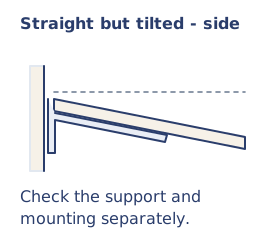
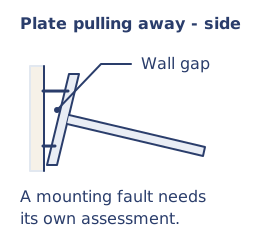
Remove the contents safely before investigating. Look separately at the shelf, support and wall: is the shelf bowed, is it loose on the support, or is the support pulling away? Do not pull, lean on or add weight to an insecure shelf to test it. If it cannot be unloaded safely, keep clear and arrange help.
Scroll across to see all columns.
| What you can see | What needs checking | Repair decision |
|---|---|---|
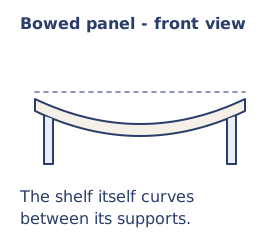
| Shelf panel curves between supports | Panel condition, permitted span and the amount and distribution of contents | Assess the panel and specified support arrangement; a wall screw cannot straighten a bowed board |
| Shelf stays straight but tips forwards | Its connection to the support, retaining parts and any bent support | Identify the moving or damaged connection before levelling; do not hide the slope with packing |
| Wall plate separates or the wall cracks | Fixings, surrounding material and actual wall construction | Assess the failed support and repair route before refitting or loading |
| A whole shelving unit leans or moves | The unit's assembly, base and specified wall securing | Use the unit's instructions; this is more than one shelf panel needing adjustment |
These observations narrow the investigation; they do not establish a safe repair by themselves. Check the exact product's mounting instructions. A damaged shelf body, bent bracket and failed wall fixing need different solutions. A longer screw through unknown construction is not a general cure for sagging.
For an assessment, send:
- A full view showing the shelf and its wall or unit, plus a side view of the slope if safely accessible.
- The model or article number, dimensions and intended contents.
- Photos of visible supports and retaining parts without removing the shelf.
- Where movement was noticed, when it started and whether the load recently changed.
The shelf-fitting service covers enquiries across Kingston, Richmond and Merton. The mirror fixing guide explains why wall construction matters. If old holes are being retired, making good the surface is separate from creating a sound new fixing.
Sources used in this guide
Need a shelf fitted?
Send your postcode, shelf link, intended contents and wall photos. Include the proposed height and any old fixing damage so we can discuss the mounting and price.
Shelf and mirror fitting enquiries are welcome from Kingston, Richmond and Merton.
Message me on WhatsApp